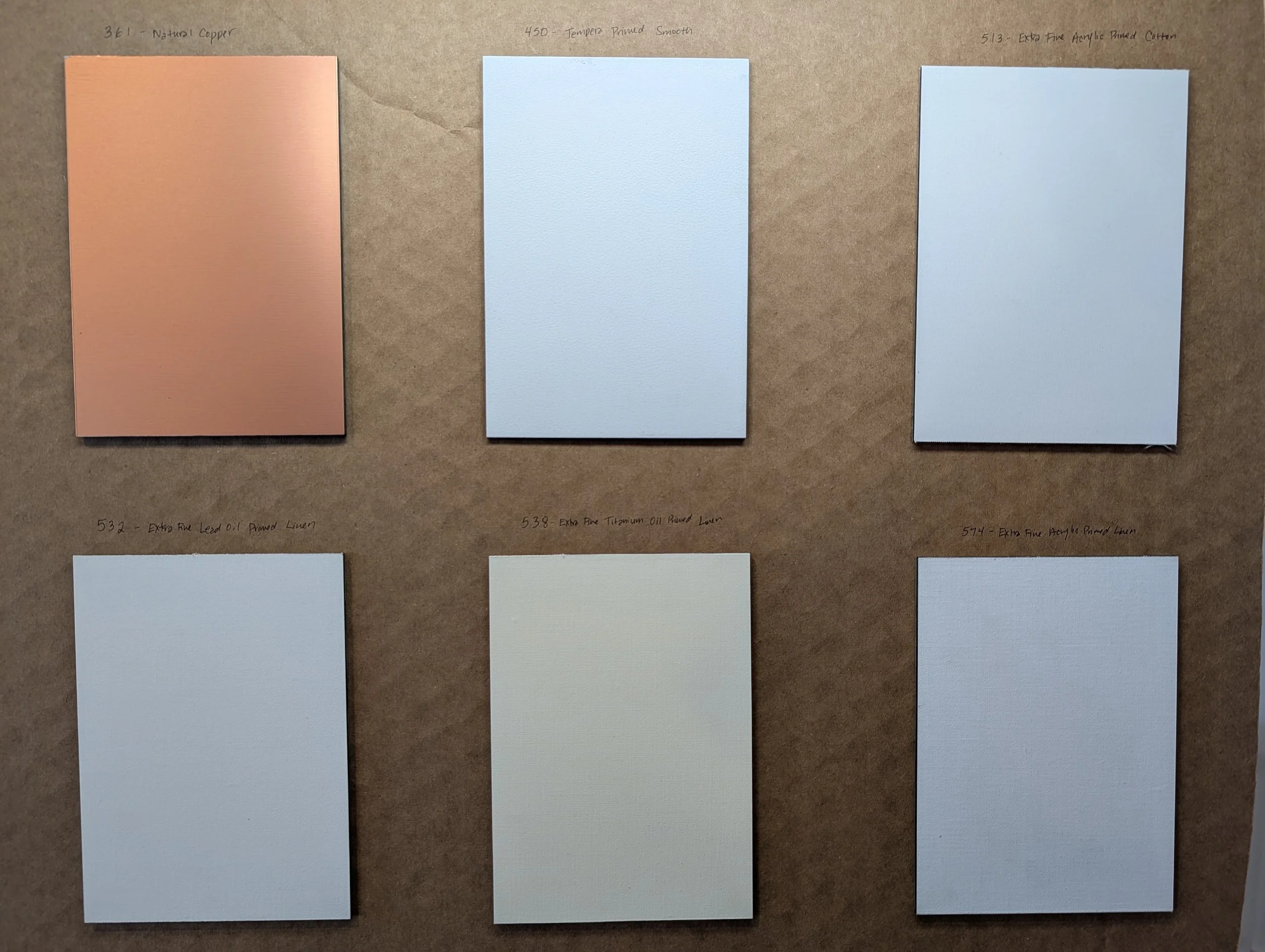
Clockwise from top left: 361, 450, 513, 532, 538, and 574 Artefex 5”x7” panel surface preference testing
INTRODUCTION
With a few paintings under my belt, I am developing preferences for my working materials. I did not appreciate just how many different types of painting surfaces there were. I have been using Julie Beck’s preferred panel for my initial paintings so following her 2022 panel test, I decided to carry out a similar personal experiment.
After leafing through Julie’s collection of surface samples and playing around with some surfaces from Blick, I was fairly confident that I was looking for something less absorbent and smoother for my painting process. My main dissatisfactions with the 538 panel was how the paint accumulated in certain places (especially in the lights) and how grippy the surface was, leaving streaky marks that I would then have to smooth out and reshape. I wanted the surface to be more conducive to my personal handling of paint.
MATERIALS
Artefex sells small 5”x7” samples of their various painting surfaces for just this purpose. The numbers are their catalog system, each one specific to a surface.
Paints
Rublev Lead White #1
Vasari Raw Umber
Brushes
METHODS
Each panel had 8 different tests. Panels were ranked on a scale relative to each other, as opposed to an absolute value.
Palette Knife Spreadability: This was the ability for a palette knife to spread paint around the surface. A small amount of paint was applied with a palette knife directly to the surface and then spread was attempted with the back of the knife. This tested for absorbency and understanding the texture of each surface.
Absorbency: Paint was applied with a brush as one would do while toning a panel. Half of the paint was wiped away with a paper towel. Panels were evaluated by how easy it was to return to the base color of the surface. This was to test surface absorbency and how slippery a surface would be, affecting how clear of painting statements I could make. This also gave me a sense of whether the “wipe-out” method of underpainting was viable on each surface.
Opaque Mark Making (vertical): Direct application of pigment with a fully loaded brush from top to bottom. This allowed me to test how quickly paint load drops off and how sticky the surface is. I was looking for something that allowed me to spread the paint evenly and smoothly while still fully covering the surface.
Opaque Mark Making (horizontal): Direct application of pigment with a fully loaded brush from left to right. Same as above.
Opaque Square: Using a fully loaded brush, make an opaque square. This is more in line in how I would first block in large shapes and begin modeling form. I tend to create organic shapes, but for this purpose a simple square was easiest. With my current very controlling process, I tend to go over an area a couple times unconsciously to smooth out the shape I made and I wanted to know how easily I could do that on each surface.
Direct Paint Change: Make an opaque square and change it to a lighter value using white. This was a crucial test because this is how I like to work. Rarely do I make the preferred paint statement in all hue, value, and chroma so I take paint from my palette and directly adjust my statement on the surface via mixing. This tests how easy it is to mix paint pigments together on the surface and what sort of marks are left behind when trying to adjust my original paint statement.
Sphere: Make a rudimentary sphere with three values. To test ease of actually making a picture, I attempted to make a sphere with a shadow. This would mimic actually working with these surfaces and my ability to make the paint do what I want.
Drying: See how long it takes for the above tests become visibly dry or dry to the touch.
Results
Personal preference ranking each surface relative to the others. Ranking easiest to most difficult for me to work with.
Palette Knife Spreadability: 361 > 450 > 574 > 538 > 532 > 513
Absorbency: 450 > 513 > 538 > 532 > 574 > 361
Note: This was not a personal preference ranking, but instead it is very clear which surfaces are factually more absorbent than others when working on them
Opaque Mark Making (vertical): 574 > 532 > 538 > 513 > 450 > 361
Opaque Mark Making (horizontal): 532 > 574 > 538 > 513 > 450 > 361
Opaque Mark Making (square): 532 > 574 > 538 > 513 > 450 > 361
Direct Paint Change: 361 > 532 > 574 > 538 > 513 > 450
Sphere: 532 > 574 > 538 > 513 > 450 > 361
Drying: 450 > 513 > 538 > 574 > 532 > 361
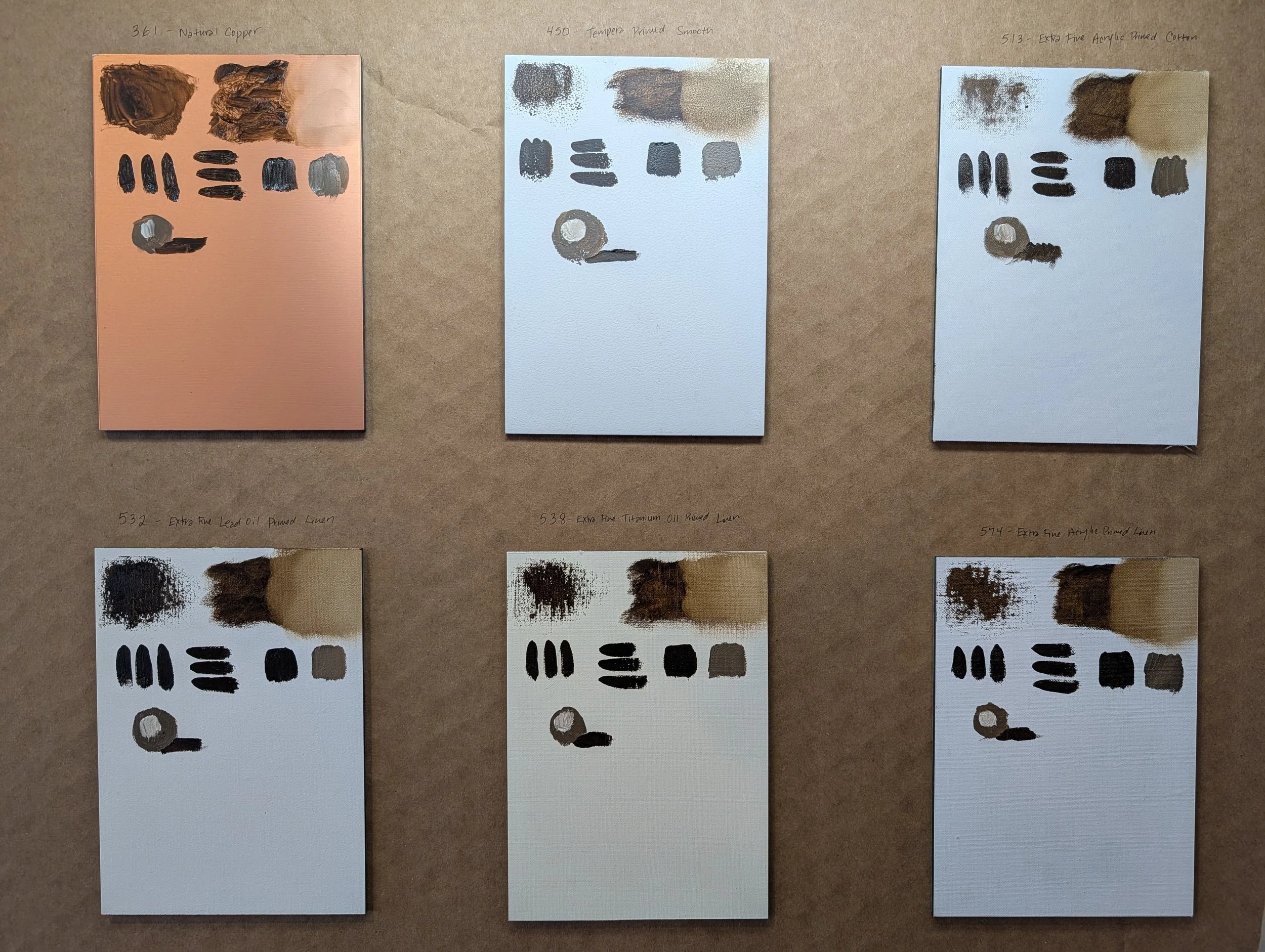
Clockwise from top left: 361, 450, 513, 532, 538, and 574 Artefex 5”x7” panel surface preference testing results
CONCLUSIONS
I prefer using Artefex 532 extra fine lead oil primed linen panel. Artefex 574 extra fine acrylic primed linen panel was a close second, but I apparently like the romantic connotations of oil and linens. The 361 natural copper surface was very interesting and relatively easy to work with, however it was very messy and impractical with the opaque oil painting process I am currently using. I am very intrigued to use it in the future for looser applications and when I care less about the drawing aspect.
As suspected, I have a preference for a surface slightly smoother and less absorbent than the 538 extra fine titanium oil primed linen I have been using. I am sure as my painting experience grows, skills change, and process evolves my preferences will change but for now I am quite encouraged by these results to make my painting process more enjoyable!
