This stems from gratitude. As a scientist, the sacrifices for innovation were not taken for granted. As an artist, I feel so lucky to be passed the traditions distilled through generations. I am forever grateful to be building on the shoulders of giants and the foundations of nature itself.
INSPIRATION
Gratitude for sacrifice
Knowledge from tradition and time
MATERIALS
Live lisianthus flowers purchased from local florist
Flower stem vases with test tube and rack
Food coloring
Oil Paint:
Vasari: Cadmium Yellow Light, Yellow Ochre, Raw Umber, Cadmium Red Light, Alizarin Crimson Permanent, Burnt Umber, Cobalt Bright Turquoise, Ultramarine Blue, Ivory Black, Phthalo Green
Old Holland: Magenta
Mediums:
Panel: Artefex 532 Allinpanel Oil Primed Linen Panel (9”x16”)
Brushes:
Varnish: Conservar Regalrez 1094 Varnish Kit
PROCESS
Useful Premixes:
Reds: Alizarin Crimson Permanent + Magenta, Alizarin Crimson Permanent + Cadmium Red Light
Greens: Yellow Ochre + Cobalt Bright Turquoise, Yellow Ochre + Ultramarine Blue
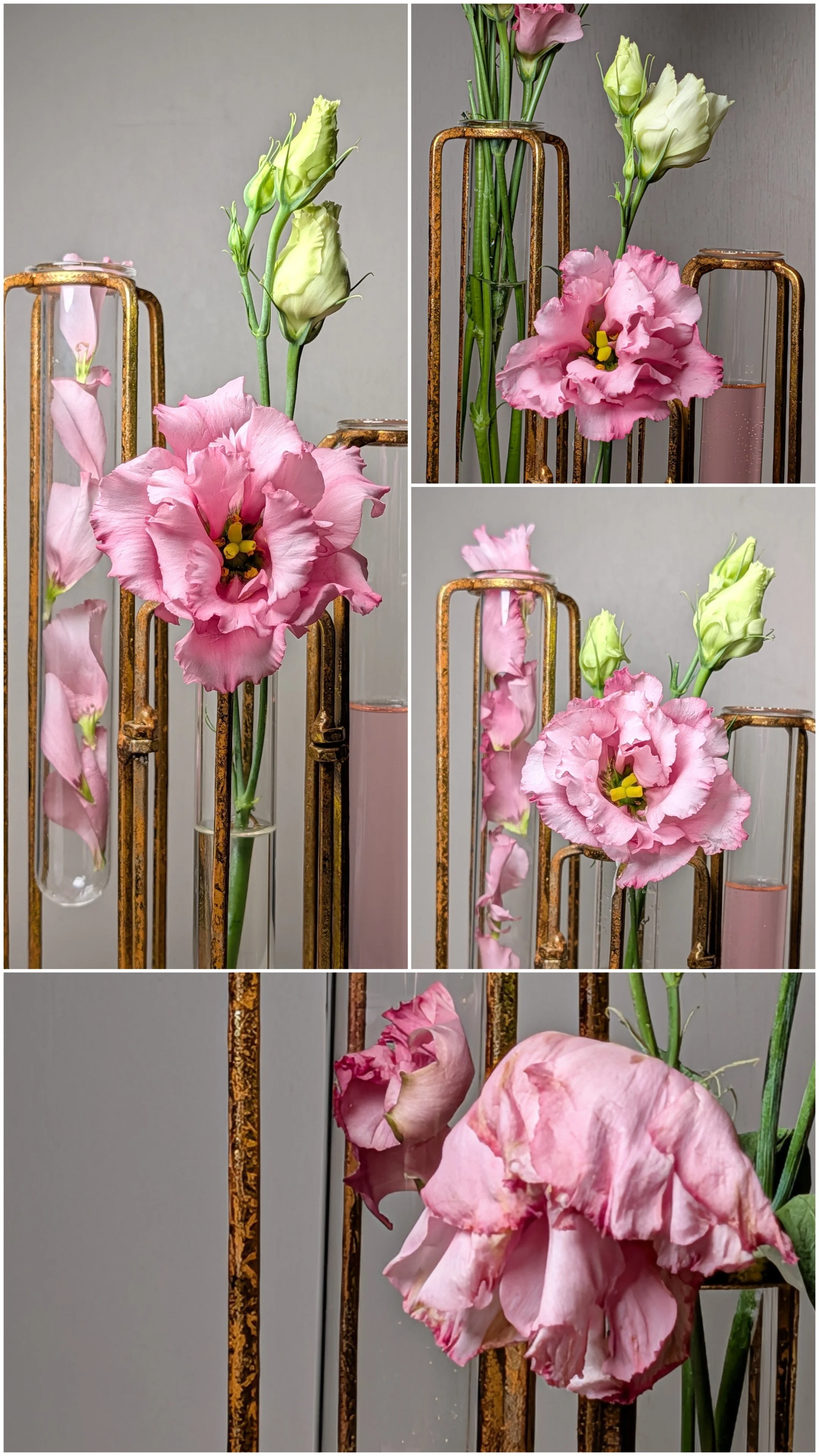
Flower reference photos from various live batches
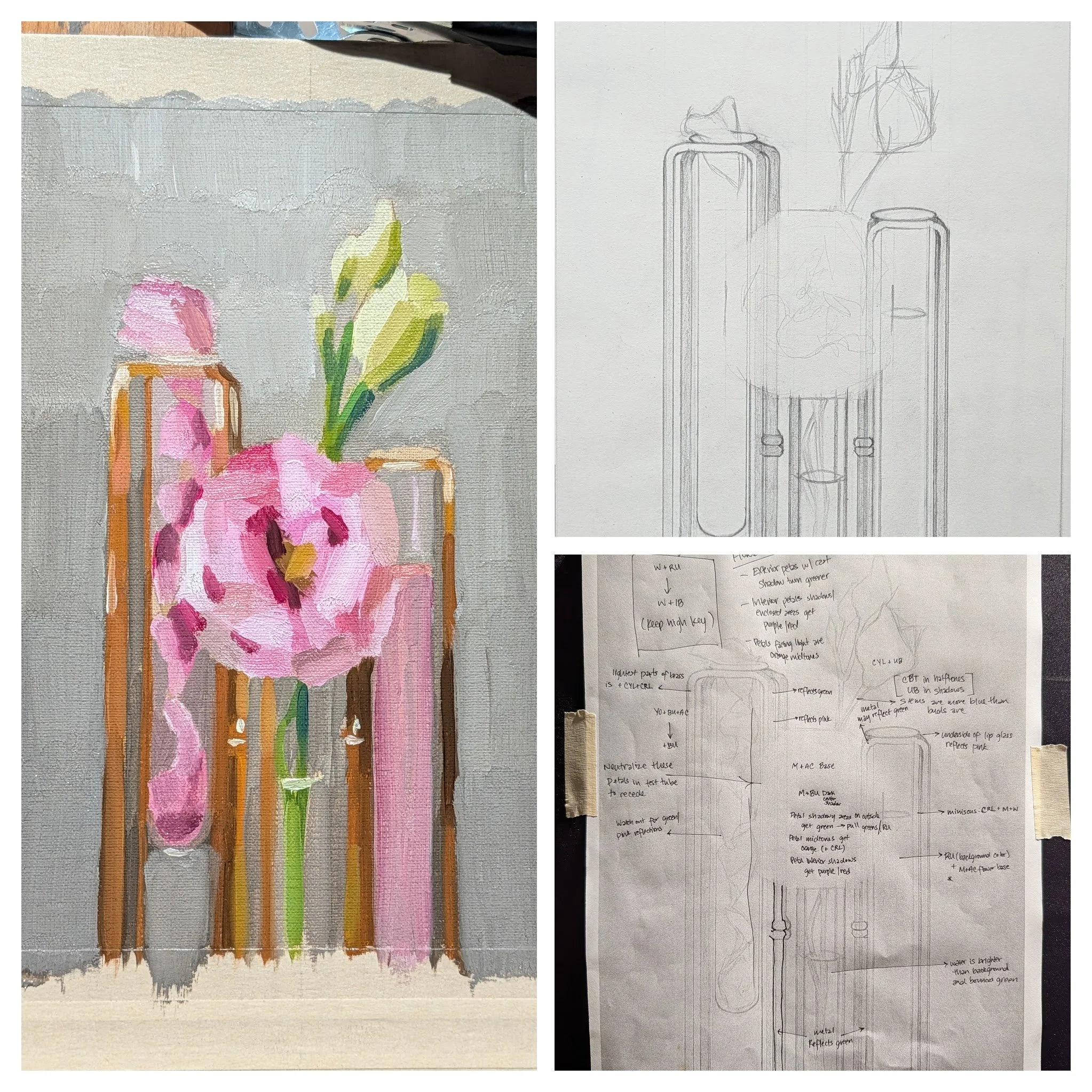
Color study, cartoon, and color study notes
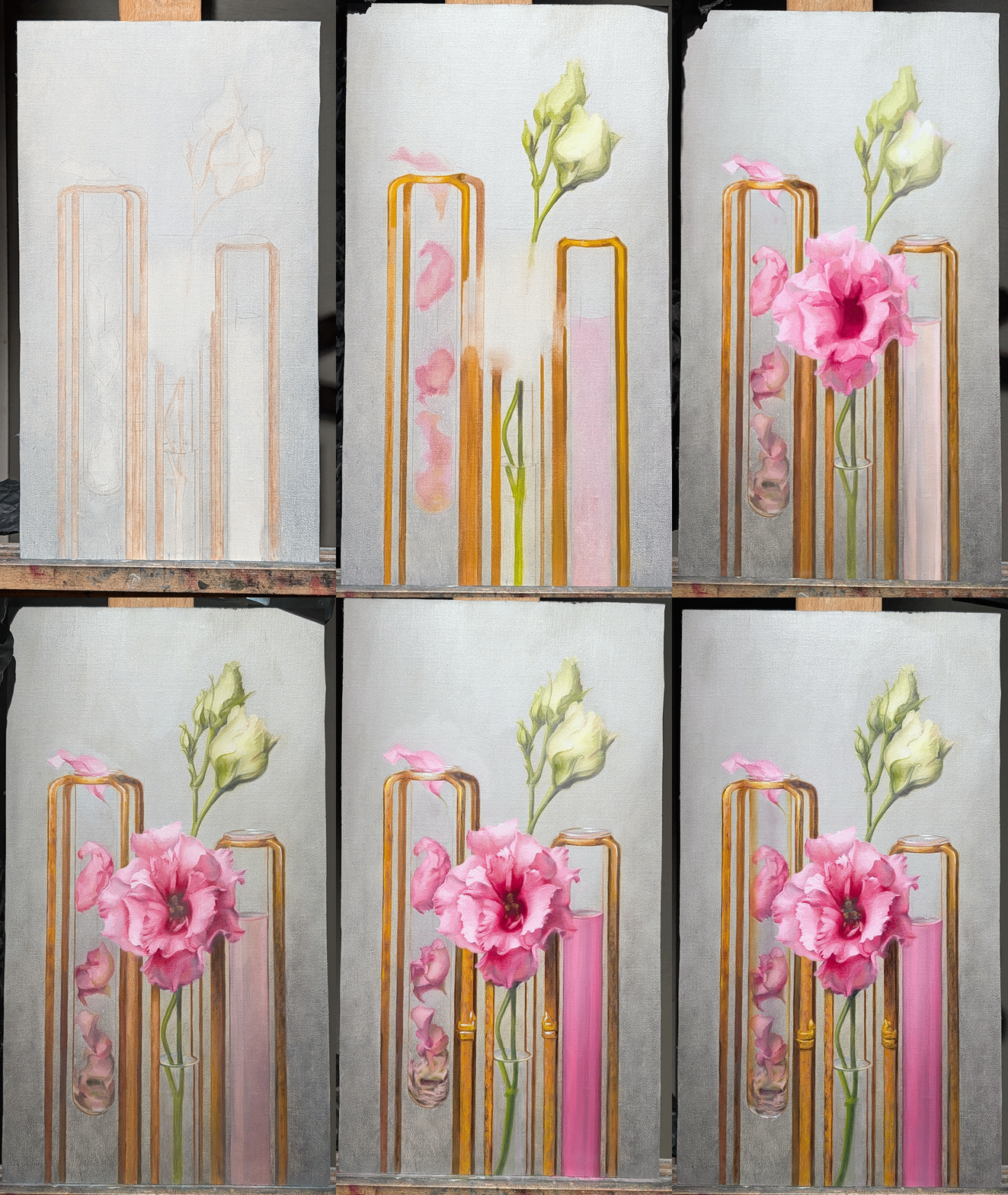
Process GIF
CONCLUSIONARY NOTES
General
Color study was incredibly important for understanding the general rules to building a convincing flower in this lighting. Things specifically to note were warm/cool changes as the flower turned away from the light and also how the inherent color of the petals affected the bouncing light. I will have to focus on color studies more if I intend to work in imaginative realism with impermanent subjects.
This was a great opportunity to evolve the piece as it develops. The decomposing petals were not originally planned for, but it became apparent they would be interesting to paint and a meaningful addition to the overall piece as the petals changed over time.
Good practice in learning how to create interest by leaning on color and chromatic relationships instead of relying mostly on value as in previous pieces.
First time working in a relatively higher key and I am unsure if this is where I want my work to go.
Focal point was decided first - center of flower. This allowed me to establish keys in which to work within for the rest of the painting. There are impasto, impressionistic colors in the center that are not found elsewhere in the painting as a gift to the viewer.
Technical Notes
Creating depth from a relatively flat setup felt very rewarding. I like creating space. This was accomplished with transparent passes of background overlapping the bronze structural elements to various degrees. If there is no overlap of background atmosphere, then it caused those specific elements to come forward (no influence from background). This was the same principle applied to push and pull the buds away from each other and create depth.
Depth was also achieved through edges. Focal point was decided to be the center ring of petals, and these have intermittent very sharp edges. The outside ring of petals is relatively soft. Comparatively, the decaying petals are unresolved. Similar logic was applied to the green buds.
My temperament finds straight architectural lines unpleasant to work on. Measurements and rulers are helpful to create them and blocking them in with a very washy pre-dead coloring layer helps retain their placements as the piece progresses.
Understanding how to not overwork something will be important. Bulk of the flower work was completed with two loose alla prima-like passes. To preserve the “energy in my brushstrokes”, it is helpful to set a time limit on the passage. After the time is up, any loose brush strokes that communicate movement and “energy” should be preserved since you are not allowed to fiddle around with them.
Ellipses should make sense with perspective and are generally created with a hierarchy of curves relative to the viewer’s eye level. The further away from the eye level, the more curved the ellipse should be.
No matter what you see in real life, the painting has to make sense on its own. The reflections on the test tube glasses were much more discrete linear reflections in real life than what they ended up being in the painting. However, when those were copied exactly they confused the viewer to be just another bronze support. These then had to be expanded and softened to read as a reflection instead of another metal support element.
